09.10.2020
Quel est le prix du risque à l'approche des élections américaines ?
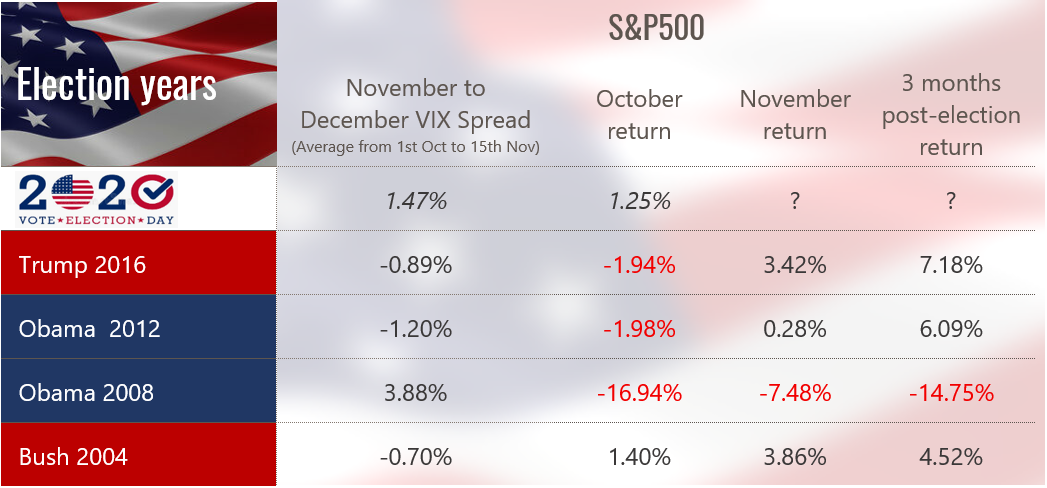
There is no doubt that a US presidential election represents a risk for financial markets and a good way to quantify how much risk is currently priced-in is to look at the forward implied volatility before and after the elections.
For that, the VIX index, a basket of the S&P 500 options volatility, sounds a good barometer.
Looking at the VIX curve, The November expiry is currently trading 1.5% above the December one, reflecting the immediate risk investors are facing post-election (November 3rd) relative to December.
While the 1.5% spread indicates a higher implied risk around and after the election, it does not quantify the absolute level of risk. To put it in perspective, we looked at the average November-December VIX Spread from October 1st to November 15th for every US Election since 2004.
Excluding the US election during the Great Financial Crisis in 2008 where spot volatility was structurally higher than 1, 2 and 3 months forward, it appears that a positive November/December VIX Spread is somewhat unusual. In fact, during the 2004, 2012 and 2016 elections, the November VIX never traded above the December one.
Looking at the return of the S&P in October, November and 3 months after the election, we can observe that it is very difficult to draw any conclusion over a US presidential election from a financial market perspective. If anything and excluding the 2008 election during the crisis, the simple and most direct conclusion would be that a US presidential election after 2000 had a positive impact on the S&P 500 Index one month and 3 months after the outcome.
So how to explain this extra-risk this time? We believe the 1.5% premium in November volatility relative to December likely reflects one single risk: if Biden wins, President Trump might not going to accept it. A sentiment that has been reinforced after the first TV debate of the US elections.
To conclude, history shows that financial markets can easily deal with a republican or democrat president but definitely not with no President after November 4th.
Autres publications
20.10.2026
Bienvenue à Dinesh Kewlram !
Nous sommes heureux d'annoncer l'arrivée de Dinesh Kewlram chez Cité Gestion.
Lire plus16.10.2026
Santé mentale : un marché en plein essor
Faisant partie des pays les plus touchés en Europe, la santé mentale est déclarée grande cause nationale en France depuis 2025. Face à des besoins médicaux considérables et après des décennies sans innovation majeure, de nouvelles découvertes émergent enfin, et notamment le grand retour du LSD.
Jérôme Berton décrypte l’un des enjeux de santé les plus importants, les principaux axes d’innovation ainsi que les sociétés positionnées pour en bénéficier.
14.10.2026
La France va-t-elle continuer à financer le passé, ou commencer à investir dans l'avenir ?
Alors que la dette, les charges de retraite et les paiements d'intérêts augmentent, la France risque de sacrifier les opportunités de demain pour financer les engagements d'hier.
Lire plus08.10.2026
Interview - Les grandes évolutions du secteur de la gestion de fortune
Dans une interview exclusive, notre CEO, Christophe Utelli, revient sur les grandes évolutions du secteur de la gestion de fortune ainsi que sur notre réponse aux défis que ces évolutions impliquent.
Cité Gestion entend offrir aux gérants indépendants une approche flexible qui conjugue liberté entrepreneuriale, excellence opérationnelle et ouverture internationale. Un modèle porté par le multi-booking, des solutions technologiques performantes et l’accès aux capacités élargies du groupe EFG.
Lire l'article05.10.2026
Nomination de Bruno Cesana et bienvenue à Jean-Christophe Faust !
Nous sommes ravis d'annoncer la nomination de Bruno Cesana en tant que banquier ainsi que l'arrivée de Jean-Christophe Faust comme Chief of Staff.
Lire plus30.09.2026
L'économie américaine peut-elle supporter un taux de rendement des bons du Trésor à 10 ans de 5 % ?
Découvrez pourquoi la hausse des taux d'intérêt, l'augmentation des coûts des crédits immobiliers et le prix élevé du pétrole n'ont pas freiné l'économie américaine.
Lire plus