07.05.2021
« Sell in May and Go away » ? Statistics say : « Not really »
Everybody has heard at least once the financial adage « Sell in May and go away », suggesting that stock markets have historically corrected in May.
As we start the month of May with the S&P 500 not too far from its all-time high and after more than 6 months of rally, the adage is on everyone’s lips. So we decided to check if May represents any kind of seasonality for a market correction.
Of course, the answer depends of the windows and the number of observations you are looking at. If we consider the S&P 500 since 2010, May has on average returned -0.7% including the awful -8.2% in 2010 (the 25th worst monthly performance of the S&P since 1942). But why look specifically at an 11 years window? Especially when the last 10 year average S&P 500 returns in May (May 2010 is not part of the observation) stands at +0.04%.
Because, with statistics, we can prove anything depending on where you are sitting…
More concretely, we cannot find any seasonality for the month of May.
Looking at the average S&P 500 return in May since 1942 and on several fixed windows, the only conclusion we can draw is that market is going up in the long-run, even in May.

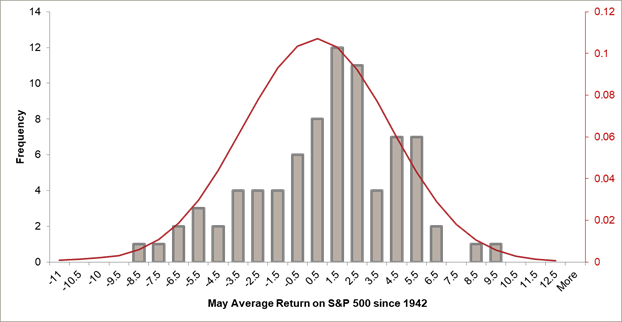
Statistics analysis since 1942 shows us that in terms of frequency, a positive return in May is even more likely to occur. However, there are drawdowns in financial market history and we tried to analyze seasonality and amplitude if any.
From 1942 to April 2021, the S&P 500 fell on a monthly basis 376 times over 953 months of observations. The distribution and the cumulative returns per month come as follows:
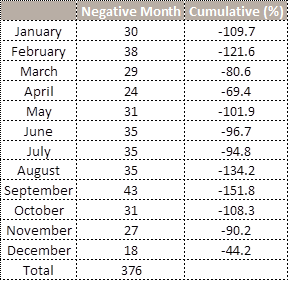
Statistics and distribution tend to confirm that the « Sell in May and Go away » is not truly confirmed over time. However, Investors could find something about :
« Sell in September and …».
More articles
26.10.2026
CGE Connect by Cité Gestion: Multiple banks, one mobile app
We are proud to launch CGE Connect, our new multi-custodian mobile app designed for both clients and relationship managers. Another step forward in our commitment to delivering independent, pragmatic and highly personalized wealth management.
Read more20.10.2026
Welcome to Dinesh Kewlram!
We are pleased to announce the arrival of Dinesh Kewlram at Cité Gestion.
Read more16.10.2026
Mental Health: A Booming Market
As one of the hardest-hit countries in Europe, mental health has been designated a major national cause in France since 2025. Faced with considerable medical needs and after decades without major innovation, new discoveries are finally emerging—notably the major resurgence of LSD.
Jérôme Berton analyzes one of the most important health issues, the main areas of innovation, and the companies positioned to benefit from them.
Link to the program14.10.2026
Will France keep financing yesterday, or start investing in tomorrow?
As debt, pension costs and interest payments rise, France risks sacrificing tomorrow's opportunities to finance yesterday's commitments.
Read more
08.10.2026
Interview - Major Trends in the Wealth Management Industry
In an exclusive interview, our CEO, Christophe Utelli, discusses the major trends in the wealth management industry as well as our response to the challenges these trends present.
Cité Gestion aims to offer independent portfolio managers a flexible approach that combines entrepreneurial freedom, operational excellence, and an international outlook. This model is supported by multi-booking, high-performance technological solutions, and access to the expanded capabilities of the EFG Group.
05.10.2026
Appointment of Bruno Cesana & welcome to Jean-Christophe Faust!
We are delighted to announce the appointment of Bruno Cesana as a banker and the arrival of Jean-Christophe Faust to the position of Chief of Staff.
Read more