14.12.2022
In Focus: Hedge funds – An alternative to Fixed Income or Equity?
Hedge funds – an alternative to Fixed Income or Equity?
Dealing with the consequences of the global financial crisis of 2008, major central banks slashed interest rates and injected unprecedented amounts of money in the economy to save it from depression. Accordingly, interest rates reached record low levels, equity returns skyrocketed above historic averages and the negative correlation between bonds and equities made 60/40 portfolios a strategy of choice. The TINA (there is no alternative) mantra – there is no alternative to equity, and the Search for Yield prevailed. In that environment, hedge funds were used as a risk management tool, an alternative to non-yielding fixed income, at perceived high cost relative to their realised below average return.
Fast forward to today, the world has structurally changed. Interest rates are back to 2007 levels, we are witnessing the return of inflation, volatility is higher in most asset classes, and sustainable trends have allowed CTAs and macro managers to outperform. The environment is just more favourable to many hedge fund strategies, if not all of them. Higher interest rates are positive for all cash + spread strategies. Arbitrageurs have more opportunities as volatility periodically pushes price relationships out of sync. Dispersion among equities is in favour of skilled stock pickers. The re-shoring of activities, the rise of China, the rethought role of energy, climate transition and the rebalancing of geopolitical powers are a fertile ground for macro managers. Finally, the looming recession is likely to offer new opportunities for distressed managers in due time.
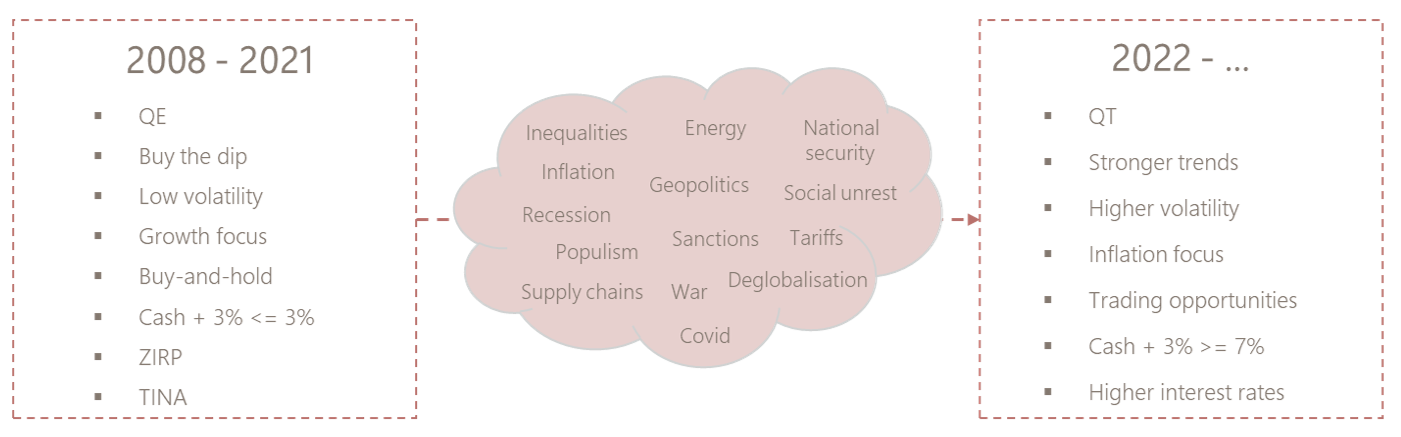
The next 10 years will most probably not look like the past 10 ones. Equity returns were frontloaded with the help of central banks’ quantitative easing. Going forward, quantitative tightening is likely to affect expected returns in the opposite way. In the years to come, hedge funds, particularly “uncorrelated” strategies, will continue to compete with Fixed Income for the role of “diversifier” in the portfolios, even if bonds are no longer yielding close to zero. At the same time, for the first time since global financial crisis, hedge funds have good chances to produce better returns than equities. Already this year, hedge funds proved again their usefulness in portfolios. Non-directional strategies performed the best, and we would favour those to complement multi-asset portfolios.
More articles
08.10.2026
Interview - Major Trends in the Wealth Management Industry
In an exclusive interview, our CEO, Christophe Utelli, discusses the major trends in the wealth management industry as well as our response to the challenges these trends present.
Cité Gestion aims to offer independent portfolio managers a flexible approach that combines entrepreneurial freedom, operational excellence, and an international outlook. This model is supported by multi-booking, high-performance technological solutions, and access to the expanded capabilities of the EFG Group.
05.10.2026
Appointment of Bruno Cesana & welcome to Jean-Christophe Faust!
We are delighted to announce the appointment of Bruno Cesana as a banker and the arrival of Jean-Christophe Faust to the position of Chief of Staff.
Read more30.09.2026
Can the U.S. economy live with a 5% 10-year Treasury yield?
Discover why higher rates, rising mortgage costs, and expensive oil have not slowed the U.S. economy.
Read more25.09.2026
Naïma Karamoko x Cité Gestion
Congratulations to Naïma on her victory in the WTA 125 Valencia doubles tournament!
Read more22.09.2026
Welcome to Ilaria Russo and Tatiana Alexandra Ward!
We are pleased to announce the arrival of Ilaria Russo and Tatiana Alexandra Ward at Cité Gestion.
Read more16.09.2026
What if $100 oil barrels are not the real risk?
The market is watching oil. John Plassard explains what may matter even more.
Read more