14.12.2022
In Focus: Hedge funds - Eine Alternative zu Fixed Income oder Aktionen?
Hedge funds – an alternative to Fixed Income or Equity?
Dealing with the consequences of the global financial crisis of 2008, major central banks slashed interest rates and injected unprecedented amounts of money in the economy to save it from depression. Accordingly, interest rates reached record low levels, equity returns skyrocketed above historic averages and the negative correlation between bonds and equities made 60/40 portfolios a strategy of choice. The TINA (there is no alternative) mantra – there is no alternative to equity, and the Search for Yield prevailed. In that environment, hedge funds were used as a risk management tool, an alternative to non-yielding fixed income, at perceived high cost relative to their realised below average return.
Fast forward to today, the world has structurally changed. Interest rates are back to 2007 levels, we are witnessing the return of inflation, volatility is higher in most asset classes, and sustainable trends have allowed CTAs and macro managers to outperform. The environment is just more favourable to many hedge fund strategies, if not all of them. Higher interest rates are positive for all cash + spread strategies. Arbitrageurs have more opportunities as volatility periodically pushes price relationships out of sync. Dispersion among equities is in favour of skilled stock pickers. The re-shoring of activities, the rise of China, the rethought role of energy, climate transition and the rebalancing of geopolitical powers are a fertile ground for macro managers. Finally, the looming recession is likely to offer new opportunities for distressed managers in due time.
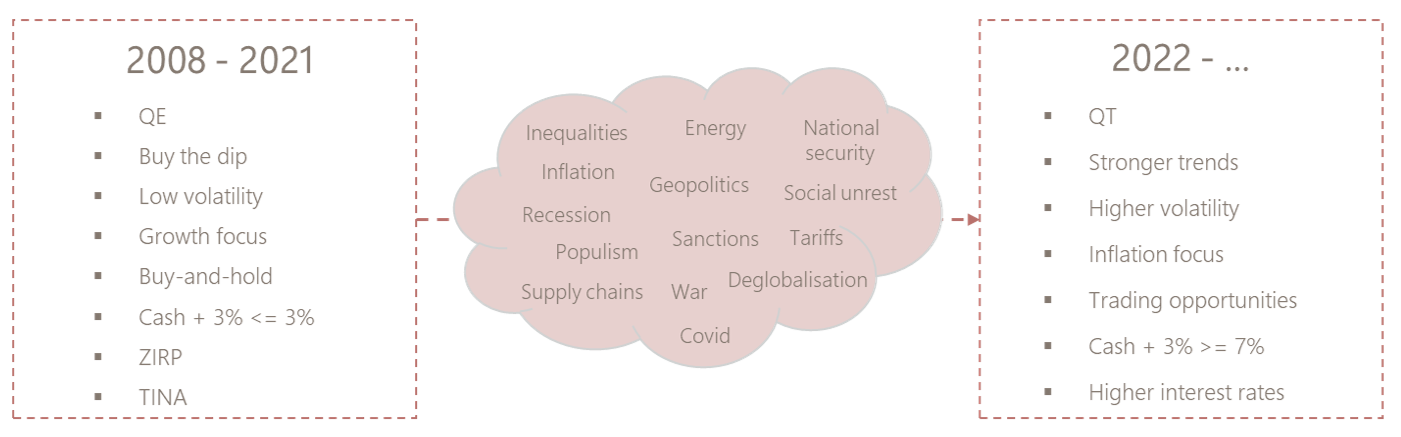
The next 10 years will most probably not look like the past 10 ones. Equity returns were frontloaded with the help of central banks’ quantitative easing. Going forward, quantitative tightening is likely to affect expected returns in the opposite way. In the years to come, hedge funds, particularly “uncorrelated” strategies, will continue to compete with Fixed Income for the role of “diversifier” in the portfolios, even if bonds are no longer yielding close to zero. At the same time, for the first time since global financial crisis, hedge funds have good chances to produce better returns than equities. Already this year, hedge funds proved again their usefulness in portfolios. Non-directional strategies performed the best, and we would favour those to complement multi-asset portfolios.
Mehr Publikationen
14.10.2026
Wird Frankreich weiterhin in die Vergangenheit investieren oder anfangen, in die Zukunft zu investieren?
Angesichts steigender Schulden, Rentenkosten und Zinszahlungen läuft Frankreich Gefahr, die Chancen von morgen zu opfern, um die Verpflichtungen von gestern zu finanzieren.
Mehr dazu08.10.2026
Interview – Die wichtigsten Entwicklungen in der Vermögensverwaltungsbranche
In einem Exklusivinterview spricht unser CEO, Christophe Utelli, über die wichtigsten Entwicklungen in der Vermögensverwaltungsbranche sowie über unsere Antwort auf die Herausforderungen, die diese Entwicklungen mit sich bringen.
Cité Gestion möchte unabhängigen Vermögensverwaltern einen flexiblen Ansatz bieten, der unternehmerische Freiheit, operative Exzellenz und internationale Ausrichtung vereint. Ein Modell, das auf Multi-Booking, leistungsstarken technologischen Lösungen und dem Zugang zu den erweiterten Kapazitäten der EFG-Gruppe basiert.
05.10.2026
Ernennung von Bruno Cesana und Willkommen bei Jean-Christophe Faust!
Wir freuen uns, die Ernennung von Bruno Cesana zum Bankier sowie den Eintritt von Jean-Christophe Faust als Chief of Staff bekannt zu geben.
Mehr dazu30.09.2026
Kann die US-Wirtschaft mit einer Rendite von 5 % für 10-jährige Staatsanleihen zurechtkommen?
Erfahren Sie, warum höhere Zinsen, steigende Hypothekenkosten und teures Öl die US-Wirtschaft nicht gebremst haben.
Mehr dazu25.09.2026
Naïma Karamoko x Cité Gestion
Herzlichen Glückwunsch an Naïma zu ihrem Sieg beim WTA-125-Doppelturnier in Valencia!
Mehr dazu22.09.2026
Herzlich willkommen, Ilaria Russo und Tatiana Alexandra Ward!
Wir freuen uns, die Aufnahme von Ilaria Russo und Tatiana Alexandra Ward bei Cité Gestion bekannt zu geben.
Mehr dazu