21.10.2020
US Elections: what are the tail risks?
A couple of weeks ahead of the US elections, we look at the potential tail risks for financial markets. First, we observe recently two facts: Biden’s lead moved from 6.5% in September to something closer to 10% as we are writing and the Trump campaign is missing financial resources while the Biden campaign does not feel the same pressure at all.
Of course, we cannot just file the election as a done deal.
The main reason is that the fraction of voters who will vote by mail will increase substantially this year and Trump has been laying for months now the pretext that mail-in voting provides too many opportunities for fraud. State agencies and lower courts are adjusting their rules to make it easier to vote by mail while higher courts are reversing those decisions. Both create excuses to challenge the results ex-post. We believe there is a 10-15% chance that the presidential election tightens to the point that each camp could claim for victory and asks authority to reverse elections results. Of course, one person will take the oath of office on January 20th, but who that will be could be unknown till mid-January. Adding to the fact that in such scenario, the new President will appear illegitimate by about half the country, we see this plausible outcome as a clear tail risk for financial markets.
In the more likely event of a Biden win and Democratic senate, it is known that policy won’t be capital friendly. Indeed, Biden plans to:
- Raise corporate taxes back to where they were before the 2017 cut
- Raise taxes on US corporations operating overseas
- Tax capital gains as ordinary income (above USD 1mio)
- Establish a minimum tax on book income
- Raise the marginal tax rate on those earning over USD 400k per year.
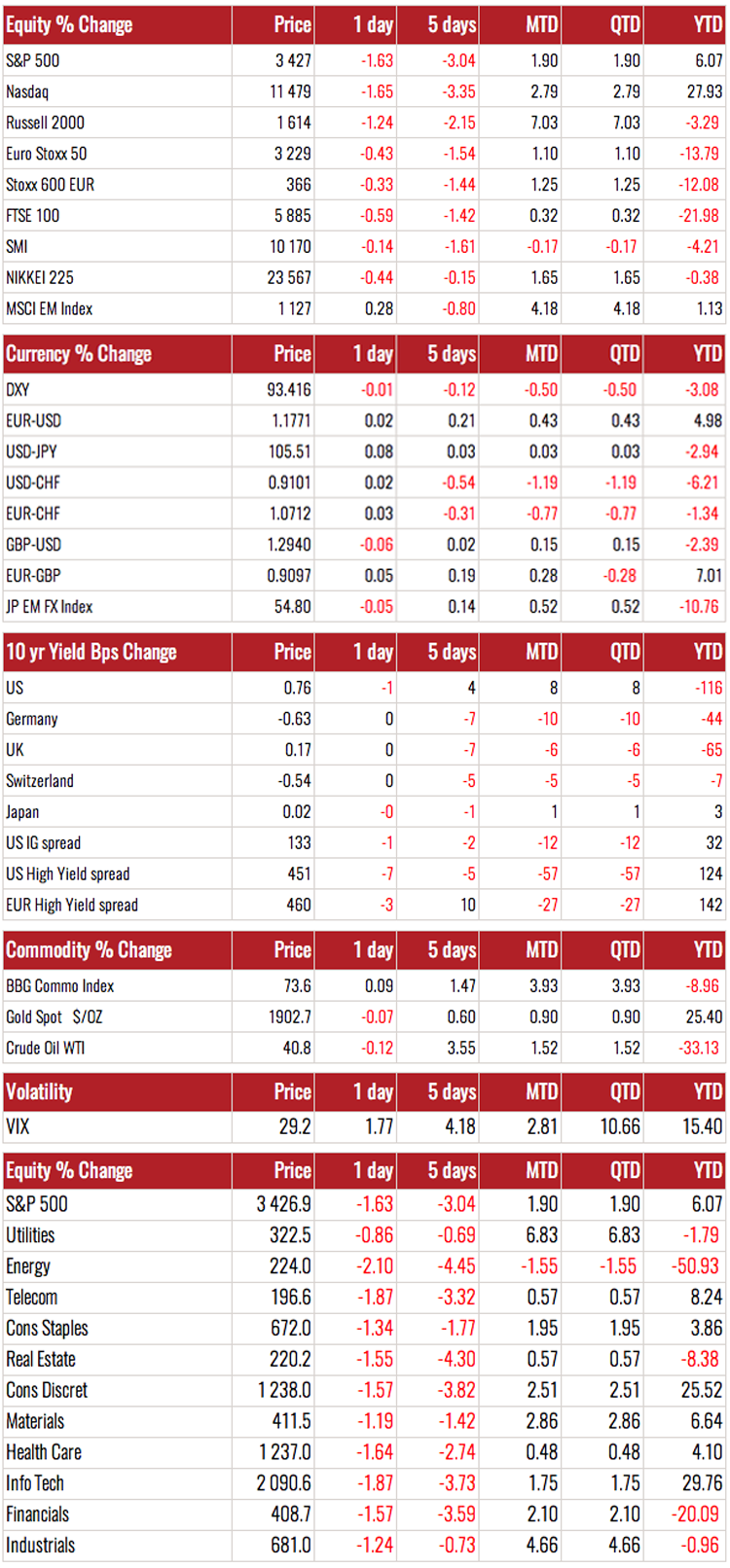
Of course, we can expect more than USD 2tn Covid- relief package with a big infrastructure bill including spending on green-energy projects and an expansion of Obamacare which might counter-balance market sentiments. Nevertheless, Biden also plans to reinstitute regulations. House Democrats have recently explored antitrust issues to Internet giants. Given their heavy weights in the US indices, the S&P 500 and the Nasdaq indices could face some selling pressure. This scenario can also be seen a atail risk.
More articles
20.10.2026
Welcome to Dinesh Kewlram!
We are pleased to announce the arrival of Dinesh Kewlram at Cité Gestion.
Read more16.10.2026
Mental Health: A Booming Market
As one of the hardest-hit countries in Europe, mental health has been designated a major national cause in France since 2025. Faced with considerable medical needs and after decades without major innovation, new discoveries are finally emerging—notably the major resurgence of LSD.
Jérôme Berton analyzes one of the most important health issues, the main areas of innovation, and the companies positioned to benefit from them.
Link to the program14.10.2026
Will France keep financing yesterday, or start investing in tomorrow?
As debt, pension costs and interest payments rise, France risks sacrificing tomorrow's opportunities to finance yesterday's commitments.
Read more
08.10.2026
Interview - Major Trends in the Wealth Management Industry
In an exclusive interview, our CEO, Christophe Utelli, discusses the major trends in the wealth management industry as well as our response to the challenges these trends present.
Cité Gestion aims to offer independent portfolio managers a flexible approach that combines entrepreneurial freedom, operational excellence, and an international outlook. This model is supported by multi-booking, high-performance technological solutions, and access to the expanded capabilities of the EFG Group.
05.10.2026
Appointment of Bruno Cesana & welcome to Jean-Christophe Faust!
We are delighted to announce the appointment of Bruno Cesana as a banker and the arrival of Jean-Christophe Faust to the position of Chief of Staff.
Read more30.09.2026
Can the U.S. economy live with a 5% 10-year Treasury yield?
Discover why higher rates, rising mortgage costs, and expensive oil have not slowed the U.S. economy.
Read more