21.10.2020
US-Wahlen: Welches sind die Tail Risks?
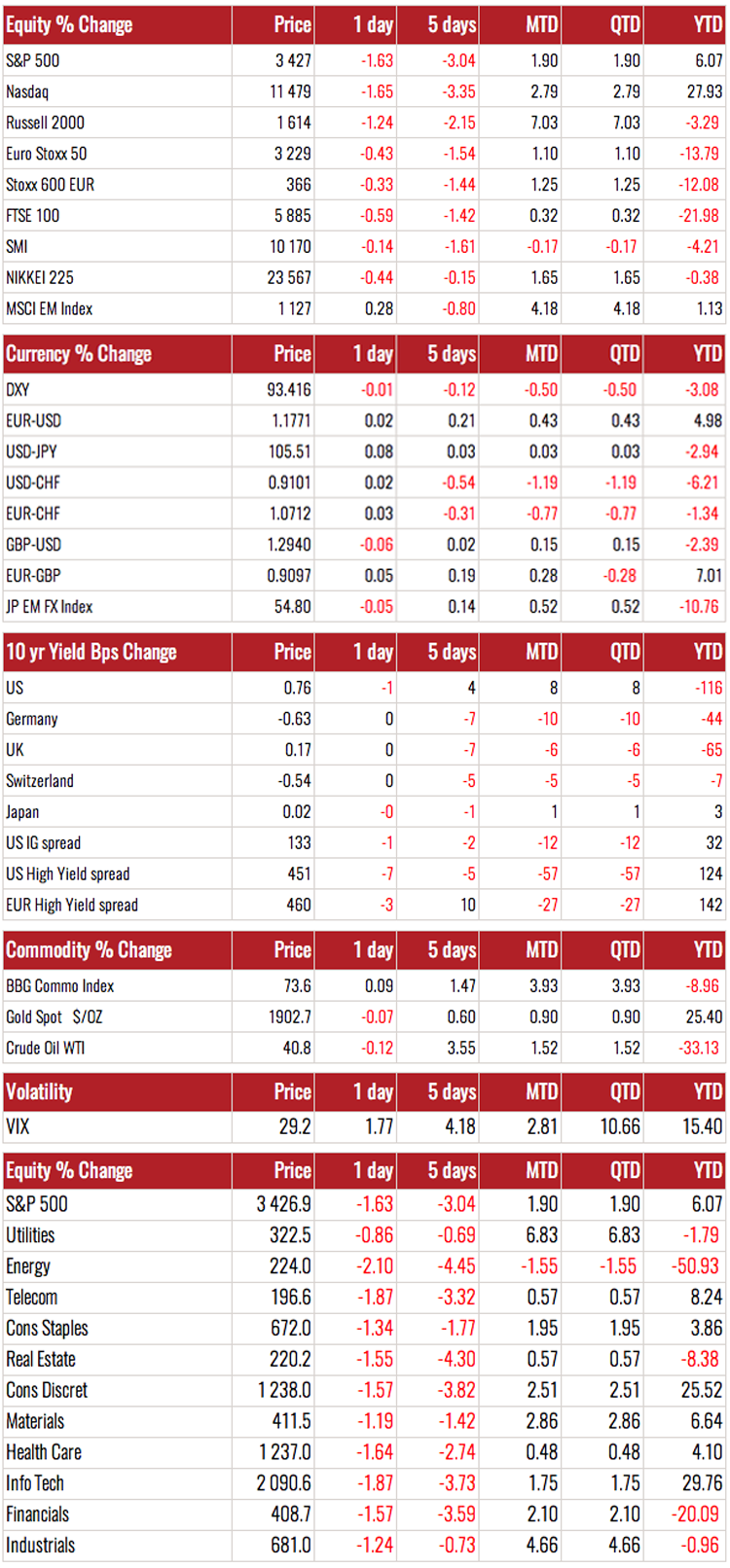
A couple of weeks ahead of the US elections, we look at the potential tail risks for financial markets. First, we observe recently two facts: Biden’s lead moved from 6.5% in September to something closer to 10% as we are writing and the Trump campaign is missing financial resources while the Biden campaign does not feel the same pressure at all.
Of course, we cannot just file the election as a done deal.
The main reason is that the fraction of voters who will vote by mail will increase substantially this year and Trump has been laying for months now the pretext that mail-in voting provides too many opportunities for fraud. State agencies and lower courts are adjusting their rules to make it easier to vote by mail while higher courts are reversing those decisions. Both create excuses to challenge the results ex-post. We believe there is a 10-15% chance that the presidential election tightens to the point that each camp could claim for victory and asks authority to reverse elections results. Of course, one person will take the oath of office on January 20th, but who that will be could be unknown till mid-January. Adding to the fact that in such scenario, the new President will appear illegitimate by about half the country, we see this plausible outcome as a clear tail risk for financial markets.
In the more likely event of a Biden win and Democratic senate, it is known that policy won’t be capital friendly. Indeed, Biden plans to:
- Raise corporate taxes back to where they were before the 2017 cut
- Raise taxes on US corporations operating overseas
- Tax capital gains as ordinary income (above USD 1mio)
- Establish a minimum tax on book income
- Raise the marginal tax rate on those earning over USD 400k per year.
Of course, we can expect more than USD 2tn Covid- relief package with a big infrastructure bill including spending on green-energy projects and an expansion of Obamacare which might counter-balance market sentiments. Nevertheless, Biden also plans to reinstitute regulations. House Democrats have recently explored antitrust issues to Internet giants. Given their heavy weights in the US indices, the S&P 500 and the Nasdaq indices could face some selling pressure. This scenario can also be seen a atail risk.

Mehr Publikationen
20.10.2026
Willkommen, Dinesh Kewlram!
Wir freuen uns, den Eintritt von Dinesh Kewlram bei Cité Gestion bekannt zu geben.
Mehr dazu16.10.2026
Psychische Gesundheit: ein boomender Markt
Als eines der am stärksten betroffenen Länder Europas wurde die psychische Gesundheit in Frankreich seit 2025 zu einem wichtigen nationalen Anliegen erklärt. Angesichts des enormen medizinischen Bedarfs und nach Jahrzehnten ohne nennenswerte Innovationen zeichnen sich nun endlich neue Durchbrüche ab, darunter insbesondere das grosse Comeback von LSD.
Jérôme Berton beleuchtet eines der wichtigsten Gesundheitsthemen, die wichtigsten Innovationsschwerpunkte sowie die Unternehmen, die davon profitieren werden.
Link zur Sendung14.10.2026
Wird Frankreich weiterhin in die Vergangenheit investieren oder anfangen, in die Zukunft zu investieren?
Angesichts steigender Schulden, Rentenkosten und Zinszahlungen läuft Frankreich Gefahr, die Chancen von morgen zu opfern, um die Verpflichtungen von gestern zu finanzieren.
Mehr dazu08.10.2026
Interview – Die wichtigsten Entwicklungen in der Vermögensverwaltungsbranche
In einem Exklusivinterview spricht unser CEO, Christophe Utelli, über die wichtigsten Entwicklungen in der Vermögensverwaltungsbranche sowie über unsere Antwort auf die Herausforderungen, die diese Entwicklungen mit sich bringen.
Cité Gestion möchte unabhängigen Vermögensverwaltern einen flexiblen Ansatz bieten, der unternehmerische Freiheit, operative Exzellenz und internationale Ausrichtung vereint. Ein Modell, das auf Multi-Booking, leistungsstarken technologischen Lösungen und dem Zugang zu den erweiterten Kapazitäten der EFG-Gruppe basiert.
05.10.2026
Ernennung von Bruno Cesana und Willkommen bei Jean-Christophe Faust!
Wir freuen uns, die Ernennung von Bruno Cesana zum Bankier sowie den Eintritt von Jean-Christophe Faust als Chief of Staff bekannt zu geben.
Mehr dazu30.09.2026
Kann die US-Wirtschaft mit einer Rendite von 5 % für 10-jährige Staatsanleihen zurechtkommen?
Erfahren Sie, warum höhere Zinsen, steigende Hypothekenkosten und teures Öl die US-Wirtschaft nicht gebremst haben.
Mehr dazu