21.10.2020
Élections américaines : quels sont les risques extrêmes ?
A couple of weeks ahead of the US elections, we look at the potential tail risks for financial markets. First, we observe recently two facts: Biden’s lead moved from 6.5% in September to something closer to 10% as we are writing and the Trump campaign is missing financial resources while the Biden campaign does not feel the same pressure at all.
Of course, we cannot just file the election as a done deal.
The main reason is that the fraction of voters who will vote by mail will increase substantially this year and Trump has been laying for months now the pretext that mail-in voting provides too many opportunities for fraud. State agencies and lower courts are adjusting their rules to make it easier to vote by mail while higher courts are reversing those decisions. Both create excuses to challenge the results ex-post. We believe there is a 10-15% chance that the presidential election tightens to the point that each camp could claim for victory and asks authority to reverse elections results. Of course, one person will take the oath of office on January 20th, but who that will be could be unknown till mid-January. Adding to the fact that in such scenario, the new President will appear illegitimate by about half the country, we see this plausible outcome as a clear tail risk for financial markets.
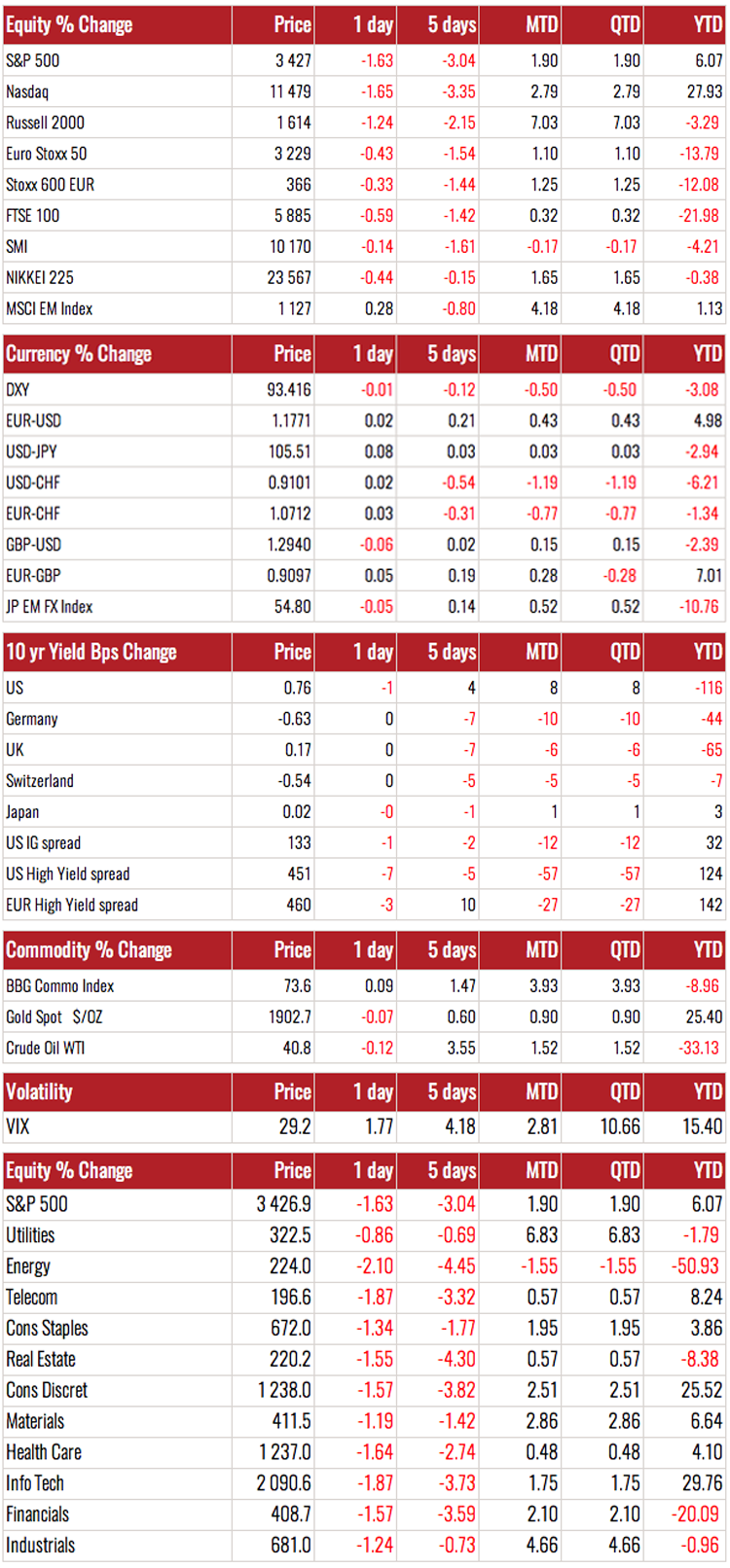
In the more likely event of a Biden win and Democratic senate, it is known that policy won’t be capital friendly. Indeed, Biden plans to:
- Raise corporate taxes back to where they were before the 2017 cut
- Raise taxes on US corporations operating overseas
- Tax capital gains as ordinary income (above USD 1mio)
- Establish a minimum tax on book income
- Raise the marginal tax rate on those earning over USD 400k per year.
Of course, we can expect more than USD 2tn Covid- relief package with a big infrastructure bill including spending on green-energy projects and an expansion of Obamacare which might counter-balance market sentiments. Nevertheless, Biden also plans to reinstitute regulations. House Democrats have recently explored antitrust issues to Internet giants. Given their heavy weights in the US indices, the S&P 500 and the Nasdaq indices could face some selling pressure. This scenario can also be seen a atail risk.
Autres publications
02.09.2026
Une économie américaine trop forte pourrait-elle masquer les pires pièges ?
Depuis 2009, les corrections boursières, telles que la chute de 34 % en 2020 et celle de 25 % en 2022, ont montré que la volatilité est le prix inévitable à payer pour obtenir des rendements ; il est donc essentiel de se tenir prêt à agir lorsque le prochain crash inattendu créera une opportunité.
Lire plus19.08.2026
Et si nous regardions le mauvais prix ?
Une analyse plus approfondie du marché de l'énergie révèle des dynamiques qui ne font pas la une de l'actualité, mais qui pourraient avoir un impact significatif sur l'inflation et la croissance.
Lire plus13.08.2026
EAM Days 2026 x Cité Gestion
Nous avons le plaisir de vous annoncer que Cité Gestion sera partenaire des EAM Days 2026 à Zurich et à Genève.
Voir le post LinkedIn05.08.2026
L'énergie nucléaire sera-t-elle la source d'énergie de la révolution de l'IA ?
L'énergie nucléaire s'impose comme l'un des principaux candidats pour alimenter la révolution de l'IA, grâce à sa capacité à fournir une électricité stable, à grande échelle et à faible empreinte carbone.
Lire plus01.08.2026
Joyeuse Fête nationale suisse !
Aujourd’hui, nous célébrons non seulement une fête nationale, mais aussi les valeurs qui façonnent la Suisse depuis des générations : la confiance, la fiabilité et l’excellence.
Chez Cité Gestion, ces principes font partie de notre héritage et constituent le fondement de notre engagement au quotidien.
24.07.2026
Et si l'Allemagne était enfin en train de se réveiller ?
Si Berlin concrétise enfin ses promesses, l'Allemagne pourrait redevenir le moteur économique de l'Europe dès 2027.
Lire plus